

Transmedics Group (TMDX) Notes

I've seen plenty of article posted on TransMedics over the last couple years but never personally gone deeper than a high-level look at what they do. A subscriber asked me to take a closer look now that the stock is down 50% from its March 2026 high, and almost 60% from its 2024 high.
I wasn’t disappointed by the company I found. But a good story and a good investment are two different things, and TMDX doesn’t clear the gap between them for me.
Recent quarters make TMDX look like a 20%+ free cash flow business. Strip out abnormal fluctuations and the real current figure is closer to 11%.
That gap makes all the difference to me, and it's why I dug into everything below. Starting with what TMDX actually does.
Welcome to 📉DeepValue Capital📈
I’m Kyler Johnson, a husband, dad, and self taught investor of 7 years.
25K+ subscribers and 259% returns from Jan 2024 to June 2026. I buy turnarounds and good companies at great prices.
Ticker: TMDX
Market Cap: ~$2.59B
TTM Revenue: $636M
Reported P/FCF: 17x
What Transmedics Does
Transmedics is an innovative organ transplant company that gets donor organs to patients quickly and in a healthy state. In 2025 they completed 5,139 donor organ cases.
They developed their Organ Care System (OCS) to replace cold storage systems that only give organ’s minimal viability window.
Cold storage is a rudimentary approach to organ preservation in which a donor organ is flushed with cold pharmaceutical solutions, placed in a plastic bag on top of ice and transported in a cooler. Cold storage subjects organs to significant injury due to a lack of oxygenated blood supply, or ischemia*. Further, cold storage does not allow physicians to assess organ viability and lacks the ability to optimize an organ’s condition once it has been retrieved from the donor. Time-dependent ischemic injury has been shown to result in short- and long-term post-transplant clinical complications and, together with the inability to assess or optimize organs, contributes to the severe underutilization of donor organs.
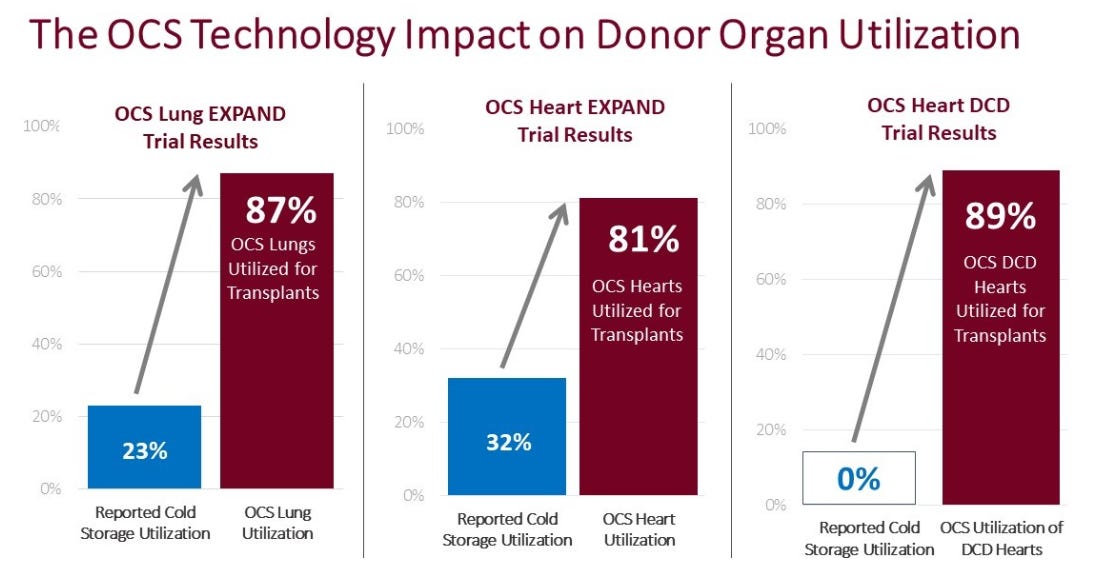
With the use of cold storage, the majority of lungs and hearts donated after brain death go unutilized, and almost no available lungs and hearts donated after circulatory death are utilized.
Source: TMDX 10K
*Ischemia is a restriction in blood supply to tissues, whereas lack of oxygenated blood (hypoxia/anoxia) is the result of that restricted flow.
With their technology hearts went from lasting 4-6 hours to 12, lungs from 4-6 to 12-24, livers from 12 hours max to 12-14+ hours.
And just as important when the organs arrive a higher percentage are still viable and in a much healthier conditions vs cold storage leading to higher success rates and less complications.
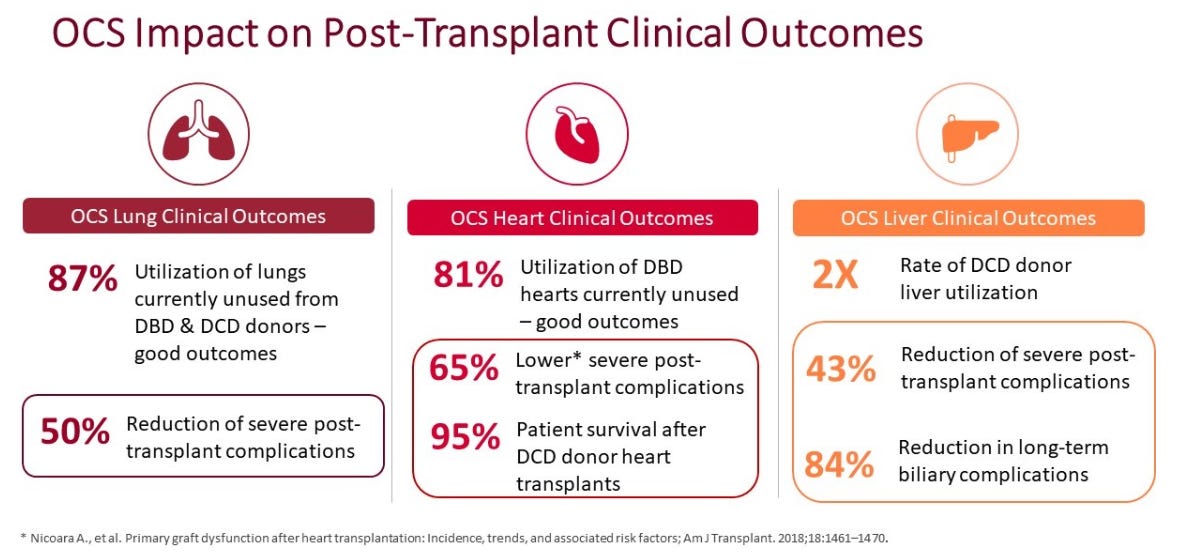
They are able to achieve such results because their OCS is designed to keep organs functioning as if they were in a body still. In their 10K they describe their OCS as, “maintaining the organs in a living, functioning state; the lung is breathing, the heart is beating and the liver is producing bile.”
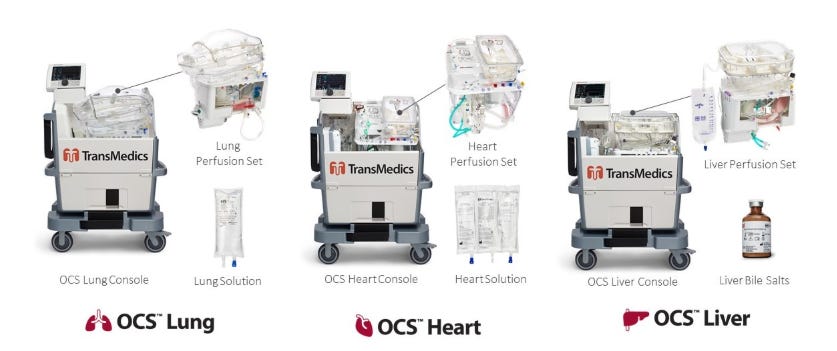
This is a unique system on Transmedics has. According to their 10K OCS is the the only “FDA approved, portable, multi-organ, warm perfusion technology platform. All three of our products, OCS Heart, OCS Lung and OCS Liver, have received Pre-Market Approval, or PMA, from the FDA, for both organs donated after brain death, or DBD organs, and organs donated after circulatory death, or DCD organs.”
So now you see how they keep organs viable but they still need to get to the patient. To make that happen TMDX has a National Organ Care System Program (NOP). Essentially a specialized logistics network complete with medical professionals they hired and jets they own to get organs anywhere they are needed in the US.
Without Transmedics transplant centers are responsible for the work of getting the organ onsite which requires additional specialized staff and large expenses. TMDX brings a lot to the table allowing better organs to arrive from further away without the need for that extra staff and cost in better condition than traditional methods.
On Transmedics side they can share the cost of owning the jets and hiring the staff between thousands of transplants performed each year resulting in lower costs for them than a transplant center would incur.
The NOP today has coverage all over the US, with TMDX's own fleet now covering ~82% of NOP missions requiring air transport. It really started to take shape in August 2023 when they acquired a charter flight operator, Summit Aviation. The fleet has been built up since then, growing from 14 aircraft in 2024 to 22 today. Prior to the Summit acquisition, their NOP service was only health care specialists that could coordinate with transplant centers.
Today with their logistics network reaching country wide and vertically integrated so they can be exactly where they are needed. This means more donated organs get used which is more lives saved and more business for hospitals.
Over 95% of revenue comes from the US but as of 2025 NOP expansion has started in Europe, particularly Italy.
How Transmedics Makes Money
TMDX operates through two models:
Transplant centers completely outsource procurement and logistics to TMDX. (NOP)
Transplant centers are trained on OCS systems and keep an inventory of all disposable products needed on hand. (Direct Acquisition)
Most of revenue today comes through NOP
TMDX bills based on a standardized national price for NOP/OCS services, with distance-based variable layered on top and a discount for failed retrievals.
The ceiling of what they can bill though comes from insurance.
Medicare reimburses hospitals for organ acquisition costs, which include organ preservation and transportation costs, on a reasonable cost basis.
Medicaid reimbursement changes state by state and can be either lump reimbursement (global) or a separate check for organ acquisitions costs.
Private insurance can be either lump reimbursement (global) or a separate check for organ acquisitions costs. Either way typical reimbursements are negotiated agreements.
Nearly half of U.S. lung, heart and liver transplants are covered under the Medicare and Medicaid programs, with the rest being reimbursed through private insurance.
Why is the Stock Down?
As of July 20th TMDX was down almost 60% from their mid 2024 high but today’s story really only starts in March of 2026. By then they had clawed back most of the losses down ~15% from all time highs. Only to tumble for the second time.
I will be covering what those recent issues have been.
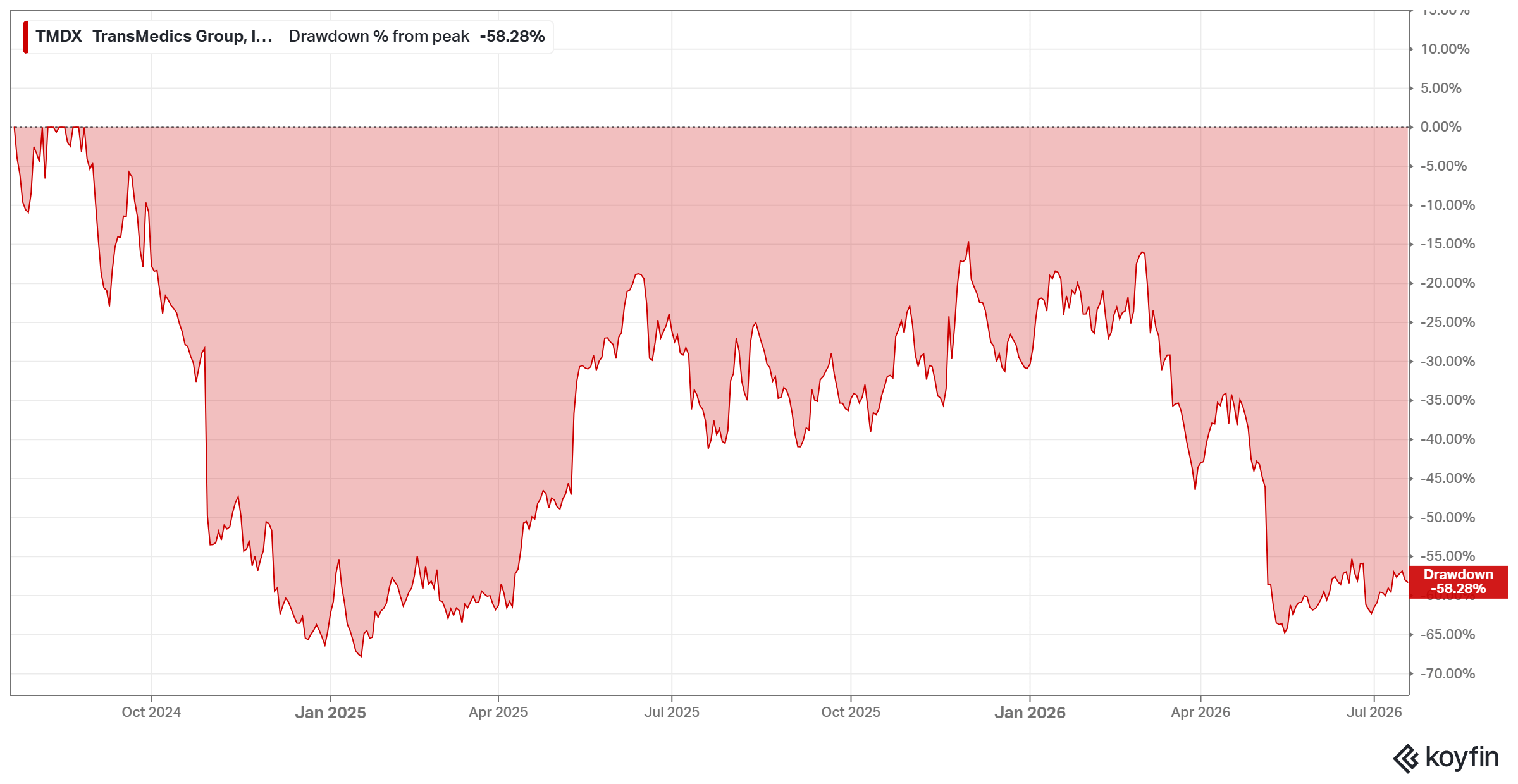
Sentiment: In March of 2026 markets tumbled on higher oil prices and the geopolitical uncertainty the Iran war brought. TMDX was not immune and as a high flying growth stock it fell over 30% that month.
Then came the concern that make me question Transmedic’s future from their Q1 2026 earnings on May 5th.
Margin Compression: Net margins came in at 4.2% down from 17.9% in 2025 driven by higher COGS, R&D, and SG&A all of which have grown much faster than revenue in the last year.
So that begs the question…
