


“With robust demand across our footprint, we’re set for sustained growth and strong returns.”
-Sam Darwish IHS CEO
This article covers IHS Holdings ($IHS). An African and South American cell tower company trading at 5x EV/EBITDA. (Click here for the TLDR Q3 Update)
After doing dozens of hours of research I first got interested in the company back in August 2024. Since then the stock is up about 160%, but it still trades at barely a third of its competitors’ average multiple despite having similar margins and lower leverage.
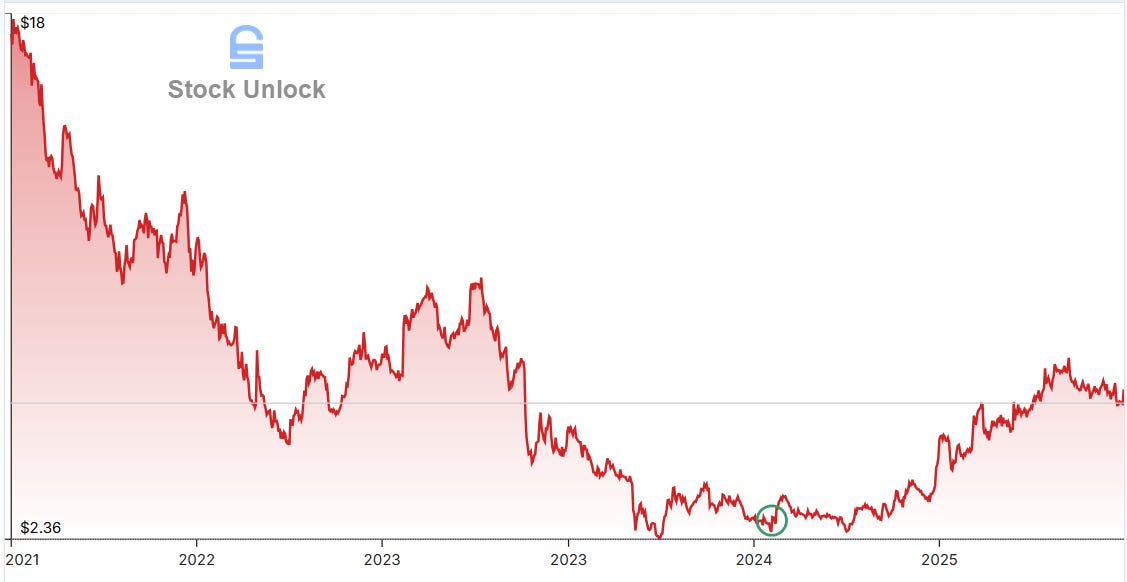
The reason for the disconnect is that the company faced major currency headwinds in 2023 and 2024 which masked a fundamentally strong and predictable business. Those headwinds are fading and they are setting up for solid growth going forward.
If you don’t know the name, I’ll walk through it all:
What they do.
My full investment thesis.
What happened during Q3.
The risks.
And why I expect $25+ per share (More than 3x from today’s price of ~$7)
To read my full disclaimer click here.
Now let’s get into it.
What Does IHS Do?
IHS Holdings is an easy to understand company. They build and manage cell towers. That’s it. If that isn’t the definition of a boring business not sure what is.
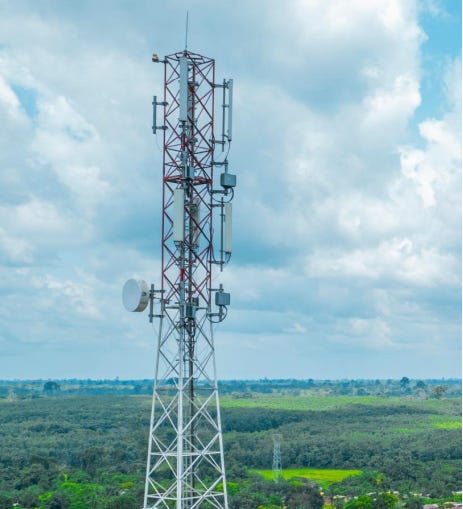
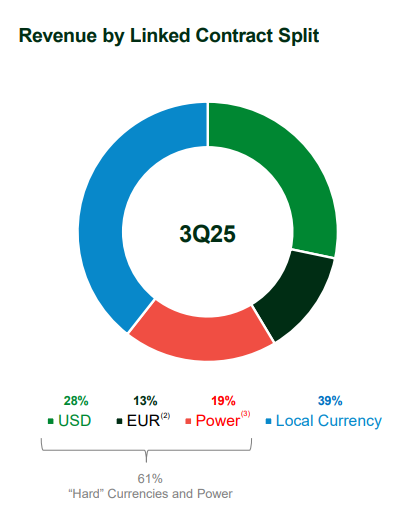
On each tower IHS builds they rent out space to mobile carriers who want to provide service in that area. These are long term, inflation-linked contracts, typically 5 to 10 years or more. For about 95% of contracts the price is reset monthly based on the exchange rate. The other 5% reset quarterly.
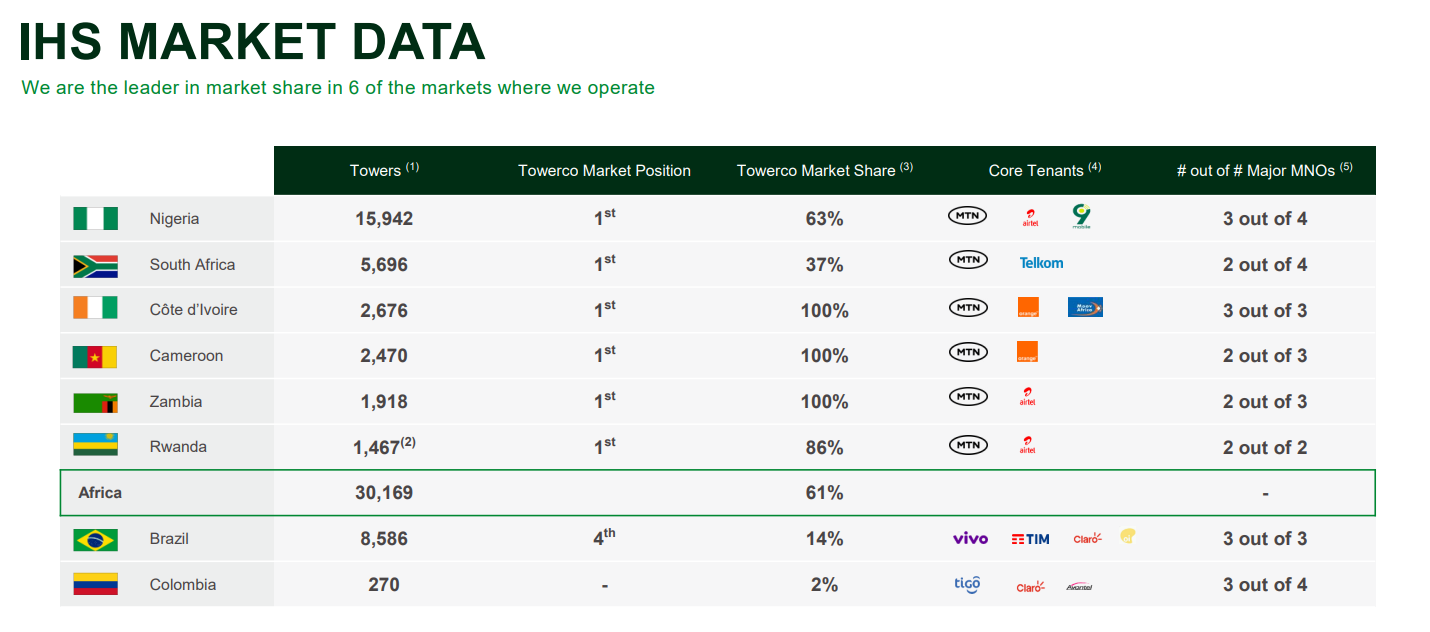
Today they operate in 8 countries across Africa and South America and are the 5th largest multi-national cell tower operator in the world.
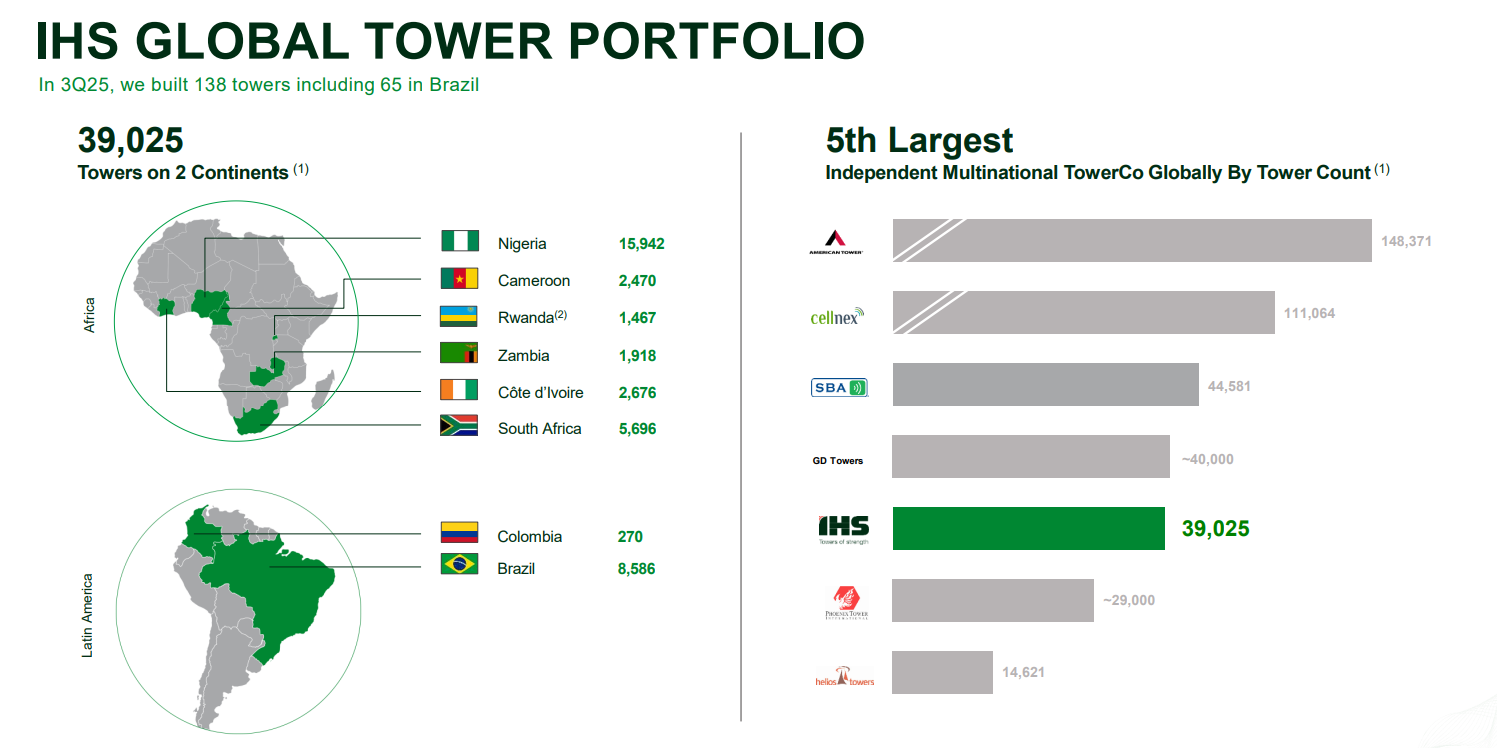
Most of their business is in Nigeria, Brazil and South Africa and between those 3 countries is more than 77% of their total towers. From a market share perspective though IHS is the #1 provider in 6 countries.
Thesis
IHS is an interesting story. On a constant currency basis their business has grown every single year. The only real issues have come from FX. So let’s walk through how that is changing and what it means for their future.
I will touch on their debt, FX changes, growth plan, macro tailwinds, competitor comparison, and finally what management laid out in Q3 2025.
So let’s get to it.
Debt
Like any turnaround story, they need enough financial runway to fix the issues. When the FX problems were most acute this was a real concern at IHS. Today that has shifted.
As of Q3 2025 they sit at 3.3x net debt to EBITDA. Well within their 3-4x target. That is $3.9B in debt, $651M in cash and just over $1B in TTM EBITDA. Notably they still have $300M available in a credit facility and $175M coming from the sale of their Rwanda business in Q4.
For context here are some of their competitors leverage ratio’s as of Q1 2025:
American Tower: 5.0x
SBA: 6.4x
Crown Castle: ~6.0–6.5x
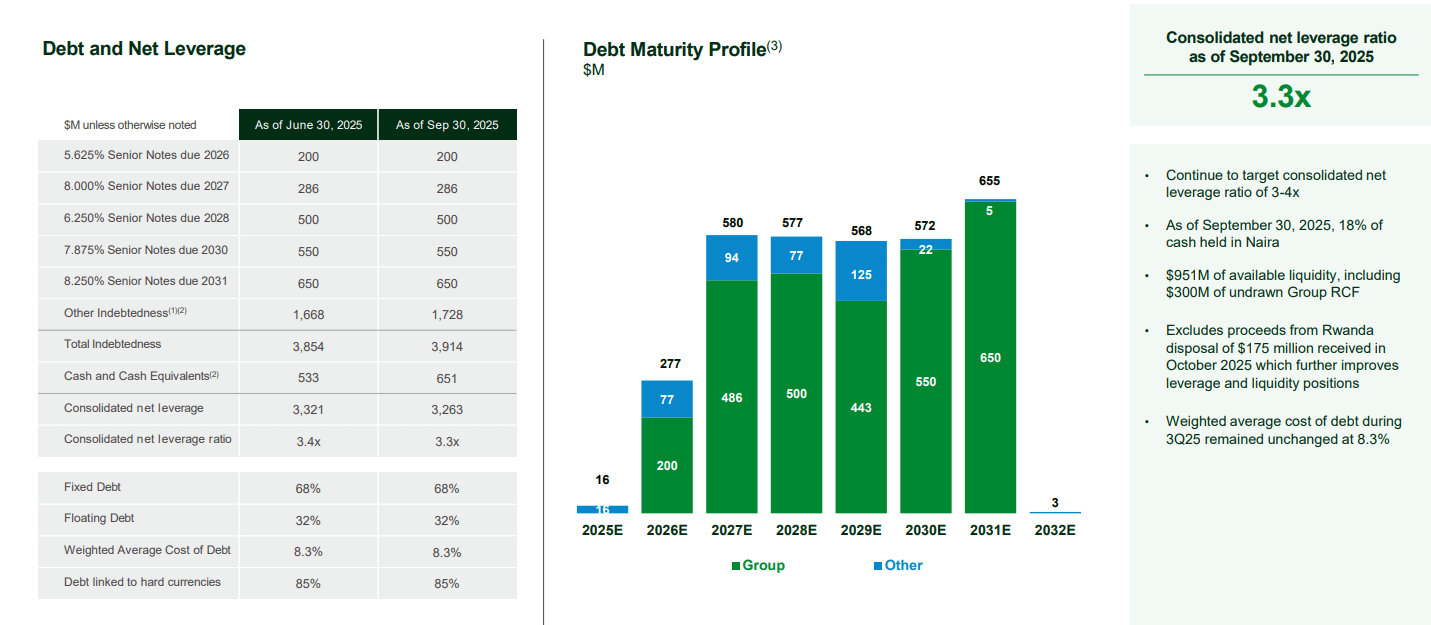
Clearly they are a company with debt but they have the assets and cash to back it up.
FX
Let’s hit the elephant in the room.
The biggest drag on IHS has been currency, specifically the Nigerian Naira. The largest part of their business is in Nigeria and in mid 2023 almost overnight the Naira lost almost 50% of its value. Then from December of that same year to March 2024 it fell another 50%. Losing 75% of its value in a year and a half.
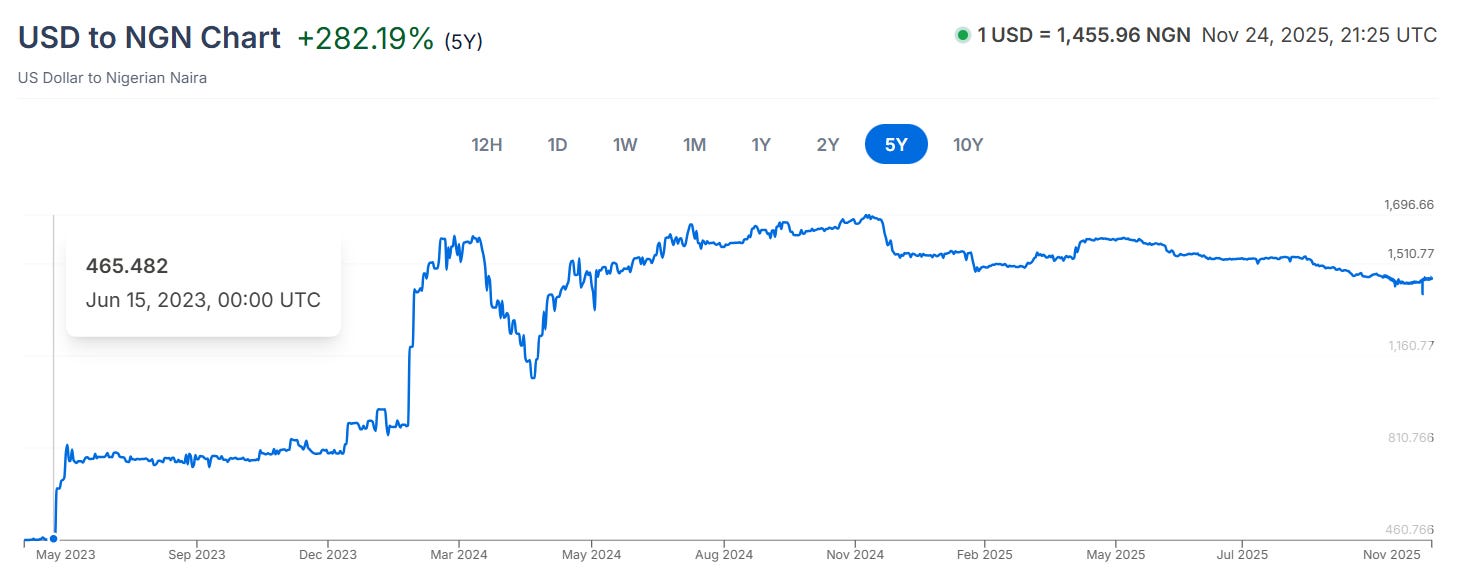
IHS is able to raise prices and quickly at that but dealing with overnight massive currency changes had an impact on their USD reported earnings and cash on hand.
Without going into too much detail these issues were rooted in poor policy. The government had fixed the Naira at an artificial exchange rate that did not match the real market rate. Once that policy was lifted the currency quickly reset and we saw rapid moves in the exchange rate.
To combat the inflation this caused they raised interest rates massively hitting 27.5% a level unthinkable in the US. And it does appear to be working. Headline inflation in Nigeria is falling from its highs over 30%.

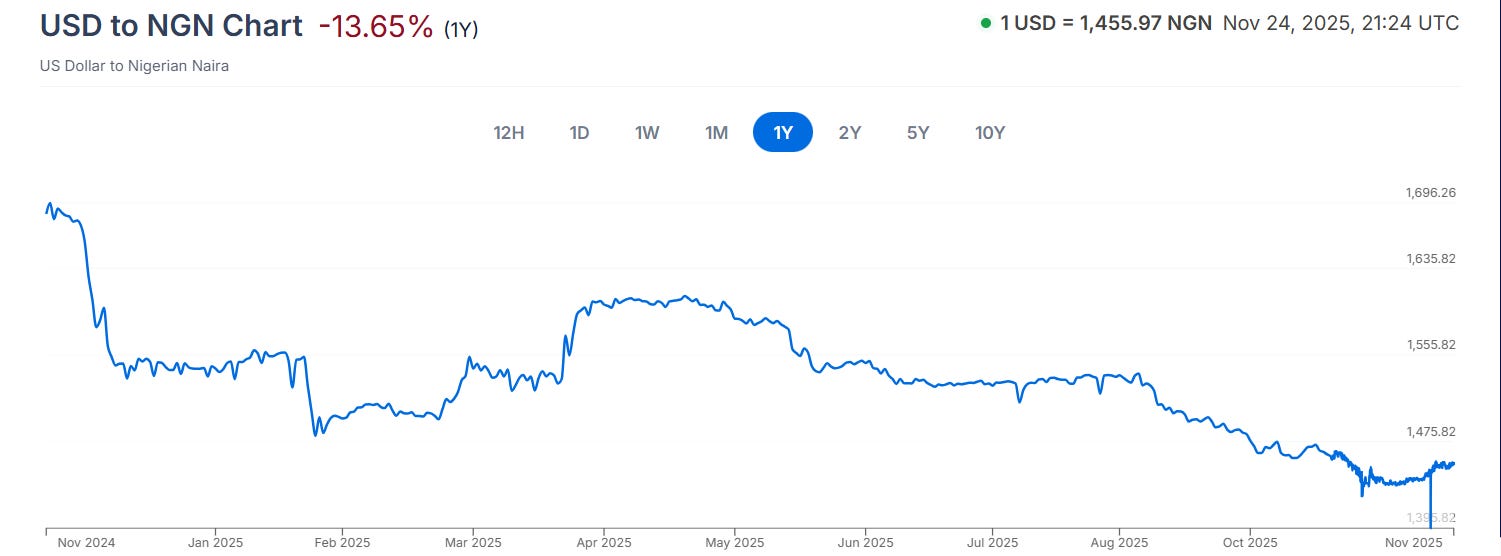
And key for IHS, the FX pressure is now rolling over. Over the last 12 months the Naira has actually appreciated by more than 13% versus the dollar, turning FX into a tailwind instead of a headwind. This has also been helped by some recent dollar weakness.
As the FX headwind continues to fade I expect meaningful margin improvements to continue. Year to date they sit at about 27.3% ALFCF, which is a record for the company driven by favorable interest expense timing in Q3 and lower capex.
On top of that they are leaner on sales and admin, with operating income margins up more than 10% versus their 2020 and 2021 peak years. As FX headwinds drop away, CPI escalations, colocations, and lease amendments should increasingly flow through to the bottom line.
Macro and Growth Tailwinds
Data usage in IHS markets is expected to grow at 21.2% CAGR through 2029. 4G/5G penetration is projected to rise from 57% in 2024 to 86% by 2029.
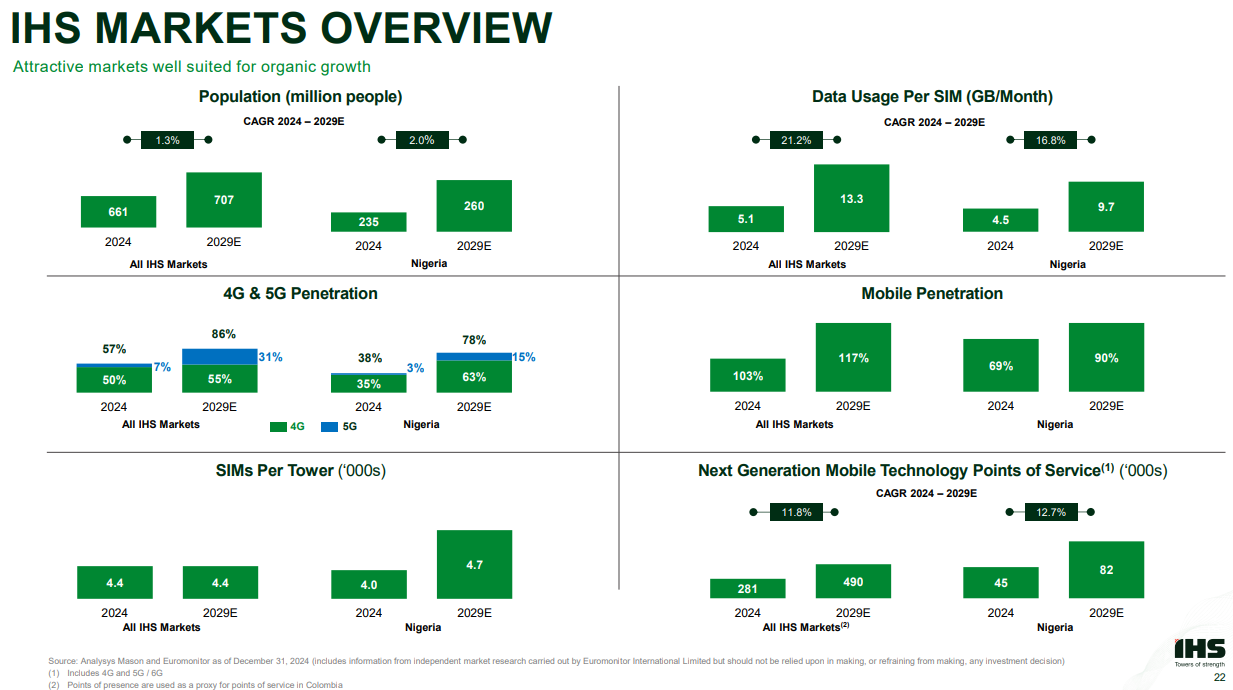
That means more users, more bandwidth demand, and more reasons for carriers to lease additional tower space.
In addition to growing usage on existing towers, IHS is constantly building out new sites to meet demand. During this quarter they announced a plan with one of the larger carriers in Brazil to build up to 3,000 new towers, with a minimum of 500 new sites across the country. If all 3,000 towers are built that would be about a 7.% increase versus their current tower count.
This partnered build out along with other plans will contribute to thousands of new towers over the next few years. YTD alone they have built 405 new sites and 718 in the TTM.
Financials Comparison to Competitors
IHS faced unique challenges from Nigeria that caused their valuation to get completely out of whack so I felt it useful to compare a few of their financials to their multi-national competitors who are publicly listed plus CCI.
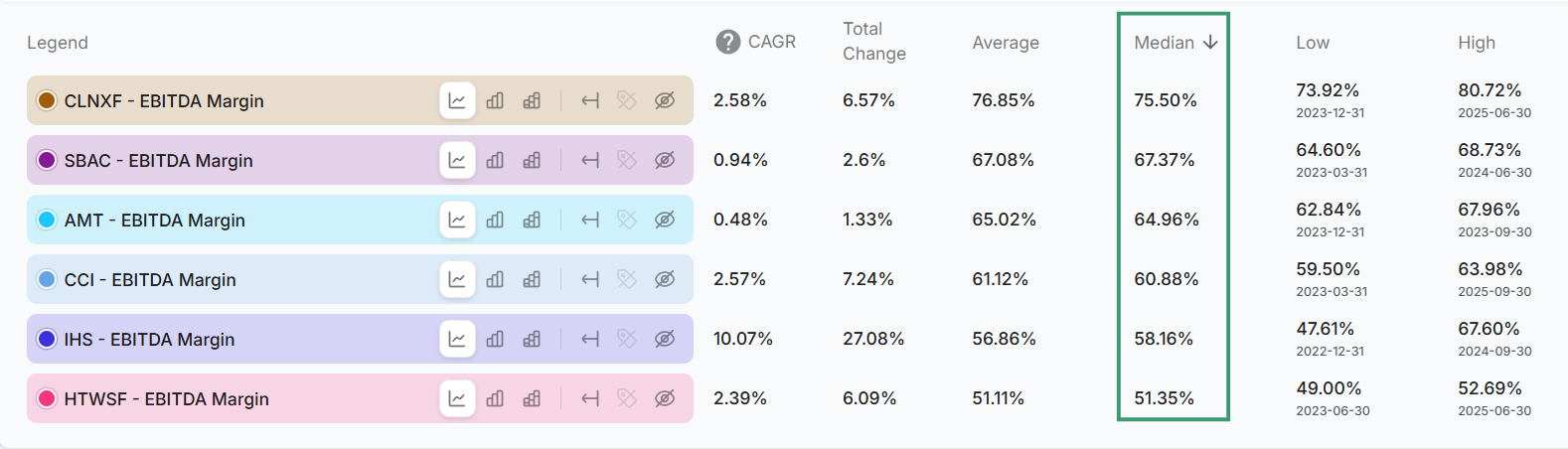
EBITDA Margins Since 2023
IHS sits slightly on the lower end but remember this includes 2 years where the currency in the largest segment devalued by 50%, twice.
Debt to EBITDA
Despite slightly lower than normalized margin currently IHS has the lowest leverage by almost 1 full turn. (Before you even account from the Q3 EBITDA which grew YoY)

EV/EBITDA
And finally their EV/EBITDA multiple is stand out low among competitors which have an average multiple of 15.14. Just to get to HALF their average current multiple IHS has ~50% upside.

Hopefully I made it crystal clear the story of undervaluation I see in IHS Holdings.
Q3 Earnings Update
Financial Overview
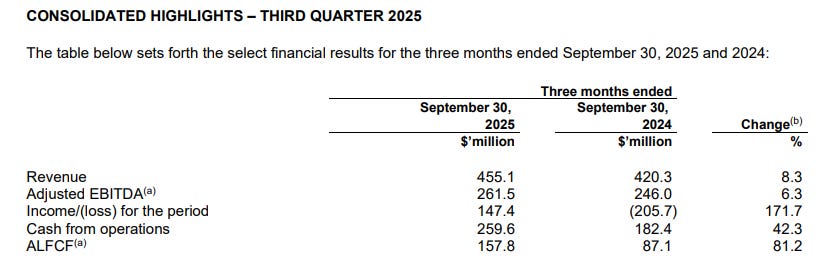
Growth this quarter is despite the divestiture of their Kuwait business which pulled revenue down 3% YoY.
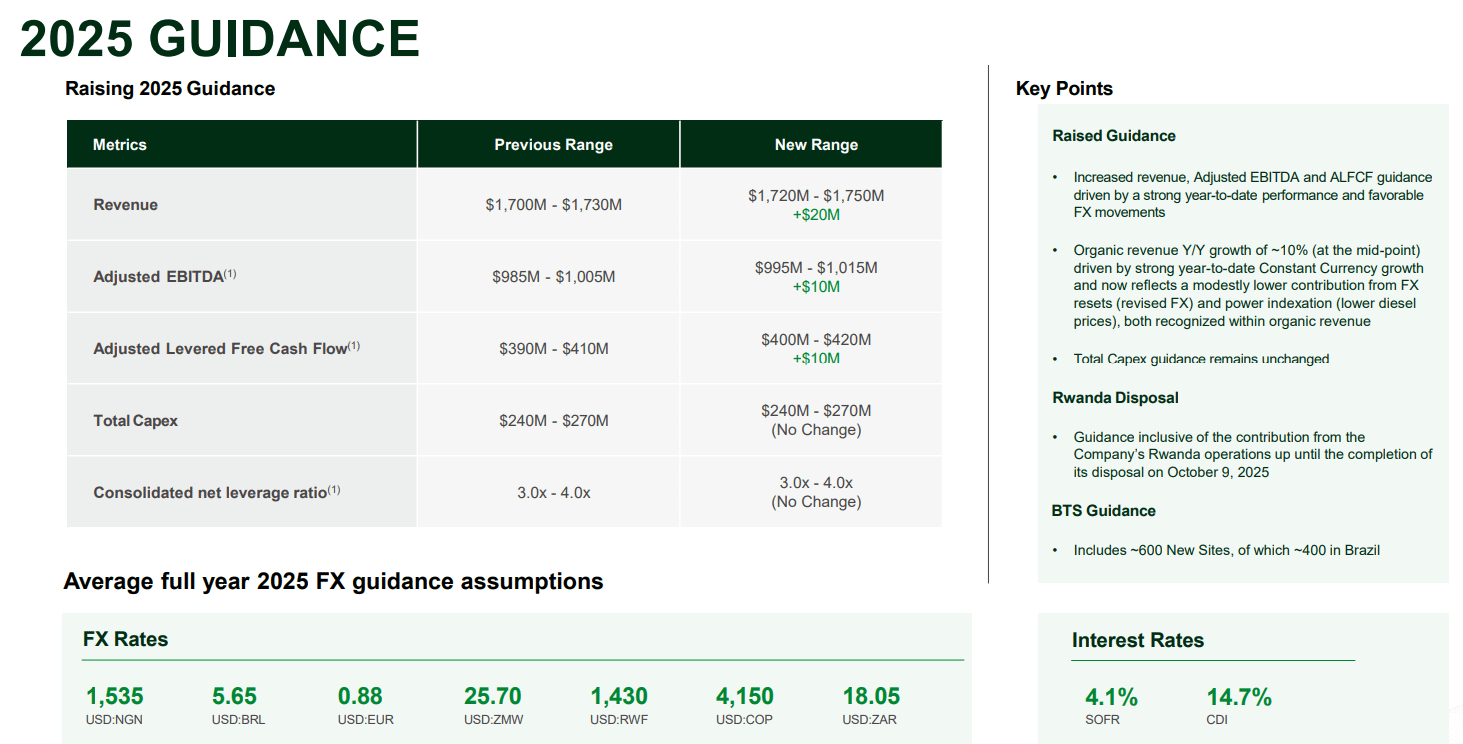
Beat and raise for the second quarter in a row.
Earnings Call
Capital Discipline
Management emphasized continued discipline with their balance sheet. Their priorities are to keep reducing debt while driving organic growth. As they approach the low end of their 3–4x leverage target, they are evaluating potential shareholder return programs, including dividends or buybacks.
Leverage is expected to end the year at 3–3.1x, supported by organic growth and the cash from their Kuwait divestiture. An additional $100M from that disposal is expected over the next 2–3 years, which further strengthens the balance sheet.
In the near term management does expect a moderate increase in growth capex to take advantage of high-return opportunities. Once those opportunities have been captured, they intend to return capital to shareholders, with more details coming on the Q4 call.
They are also considering additional disposal opportunities to further concentrate the business on core markets and highlight the value of the remaining assets.
Growth Outlook
Management raised guidance this quarter, which now assumes roughly 10% organic growth at the midpoint. Brazil remains a key area of expansion, and even beyond the build-out plan announced with TIM, they expect additional tower development in the country.
Improving operational efficiency is another major focus. Management plans to continue integrating tech and AI into their operations to create further cost savings and scalability. Across their footprint they also continue to identify and pursue additional organic growth opportunities, with several initiatives already underway.
And importantly, when you strip out the Kuwait sale and the one-off churn from 9mobile and MTN, the underlying growth metrics this quarter were strong. IHS added 1,652 net new tenants year-over-year, completed 2,800 lease amendments in the quarter, and added 220 new colocations in Nigeria alone.
Business Stabilization
Management confirmed this quarter should represent the trough in tower count. The declines over the last year were tied to one-off reductions from churn and a customer vacating certain sites.
With those headwinds now largely behind them, IHS delivered a solid quarter with strong financial results. This appears to mark the bottom for the churn-related noise they have been managing. The business is now positioned for cleaner, more consistent growth going forward.
Risks
Execution
This is a multi-country asset heavy business, even with simplification moves, it takes strong operations to keep margins high and churn low.
In Q3 2024 we saw their largest customer MTN cancel contracts to manage 1,050 towers in Nigeria and award the business to a competitor. This has been a drag on their business during the last 4 quarters on a YoY comparison. Then most recently in Q3 IHS saw a one time 2,576 tenant churn from their smallest customer 9mobile. They are vacating IHS’s sites as part of an agreement to settle some of their overdue balances. In other words IHS is waiving some debt to get them to leave so they can get customers that will pay in their place.
These two events are not common, but it will be important to watch for any further deterioration in tower count, customer churn, or related operating metrics.
One major reason I am not overly concerned about MTN signing contracts with a competitor is that they are a massive shareholder in IHS, owning more than 25% of the company. They had issues with IHS leadership in the past and I believe that contract churn was more of a wake up call that they mean business and want IHS to comply. In the end they did change rules about the voting rights of shareholders so it was resolved.
FX and Country
As 2023 and 2024 proved operating in emerging markets does not come without risks. If we were to see a similar massive currency value erosion in one of their 3 major markets like Nigeria they would face similar headwinds.
I do not believe this is likely. Events like that are not common and were largely the result of artificial policy decisions.
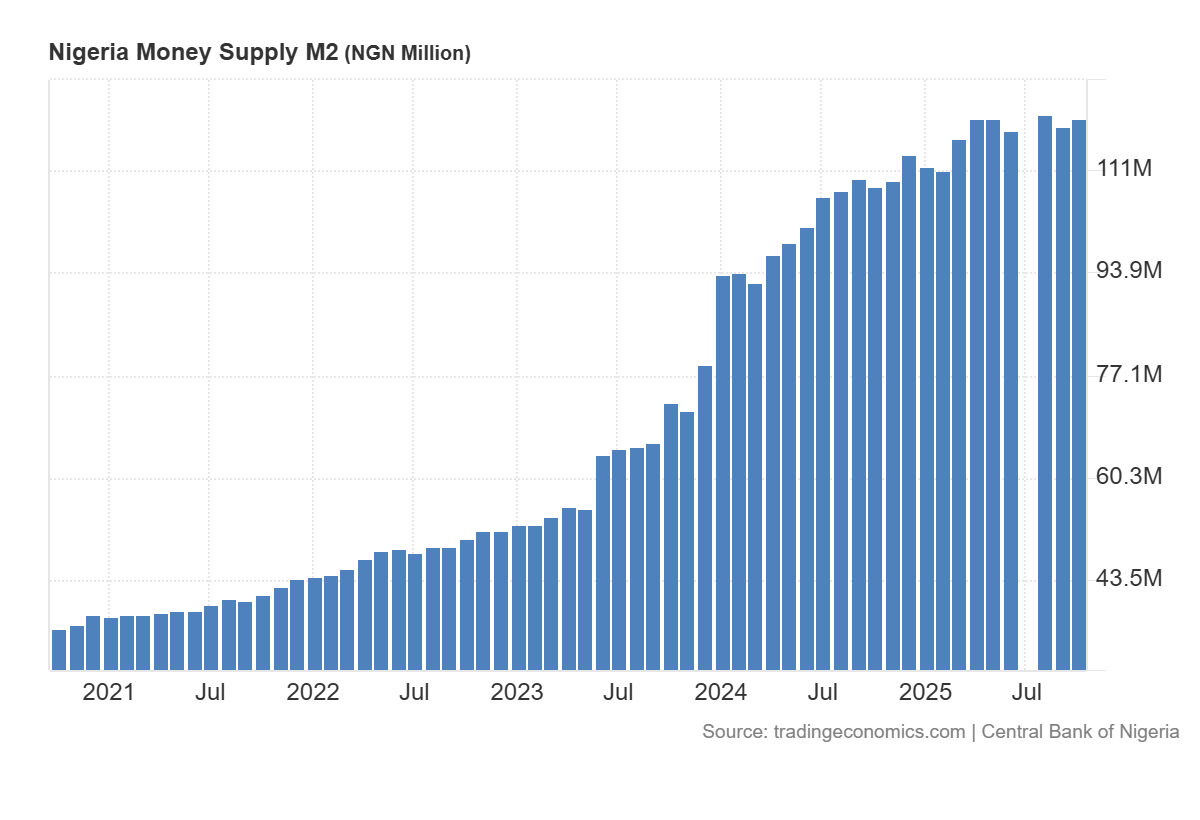
Now Nigeria is on a much different path with their money supply stagnating since March of 2025. IHS can handle inflation and currency devaluation fine at even a modest pace so excluding any major overnight events like we saw before it should be much smoother sailing.
Valuation
Given IHS’s business is slow moving my valuation looks out to 2029. I model their adjusted levered FCF over that period to give them time to improve the business structurally, grow, and regain investor confidence.
First for revenue after a rocky 2025 with low single digit growth I expect low double digit annual growth out to 2029 driven by new sites, inflation, colocation, and lease amendments.
2029 Revenue: $2.8B
Moving to margins I am forecasting a proportional increase in taxes paid, lease and rent, and maintenance capex. However for their other largest expense, interest payments, I am forecasting total debt increases to $5.5B, from $3.9B today, and their interest rate will fall from the 8.3% today to about 7.5% in the future as they strengthen fundamentally and rates are cut globally.
They will take on debt to expand and build out towers but with the Naira devaluation behind them not all their growth will be debt funded.
2029 ALFCF Margin: 28.5%
2029 ALFCF: $798M
Finally to multiple IHS has traded below 10x ALFCF since 2021 but after years of stabilization and improvements I believe they could easily hit about 12x.
From an EV/EBITDA standpoint I expect around a 10x multiple. That would be consistent with about $1.5B in EBITDA and roughly 53.5% margins, which is almost exactly in line with 2024 adjusted EBITDA margins.
These multiples get us to the following implied market cap and share price assuming a small increase in share count to 336.4M by 2029.
2029 Market Cap: $9.57B
2029 Share Price: $28.52
From today’s share price of ~$7 this is more than 310% upside or a 41% CAGR until year end 2029. IHS is a fundamentally solid business that investors have been cautious of because of the Naira devaluation. Over time those jitters will fade and it will get rerated to match peers and I will be happy to watch them compound.
Today, if I were opening a new account, anything below $6 is a level where I would be happy to start a 5% position in this company and be ready to add on further dips. They have a strong story but also real country risk that cannot be ignored, even if I believe the odds of a repeat shock are low.
4 More Articles You’ll Love
DV Capital | Comstock | Deep Dive Quarterly Update
DV Capital | Tactile Systems | Lymphedema Specialist with 30%+ CAGR Upside
DV Capital | Cooper Standard | Deep Dive Quarterly Update
DV Capital | Advanced Auto Parts | Turning a Retailer into Gold
IHS Holdings looks like one of the more misunderstood EM infrastructure plays. The market priced it as “broken” after the Nigerian FX collapse—but now that the Naira has stabilized, the real business is showing through. The stock still trades at ~5× EV/EBITDA while global peers average 12–15×. Massive disconnect.
Not without risks (Nigeria, FX, governance), but the setup for a multi-year re-rating is compelling.
I wonder if there will be any impact as a result of the recent U.S.–Nigeria relations. A stronger USD = Naira weakness, which matters for IHS reporting. Nigeria depends on U.S. support for anti-terror efforts. Trump tends to scrutinize foreign aid more aggressively. This should not directly affect IHS towers, but indirectly, stronger USD would hurt Naira translation (more FX related risk).